Balatro explained before you start
Who made the poker roguelike, when it shipped on each platform, how a run is actually structured, why PEGI moved it from 18 to 12, and what to know first.
Balatro is a card game made by one person that outsold most of what a hundred people shipped the same year, and it is the rare current release you can be fully introduced to in a single page. This one gives you the developer and publisher, the dates and platforms with their sources, what a run actually consists of, the age-rating dispute that briefly pulled it off console stores, and what is worth knowing before the first run. Every date, figure and quotation below comes from a page in the Sources list, read on the day of writing.
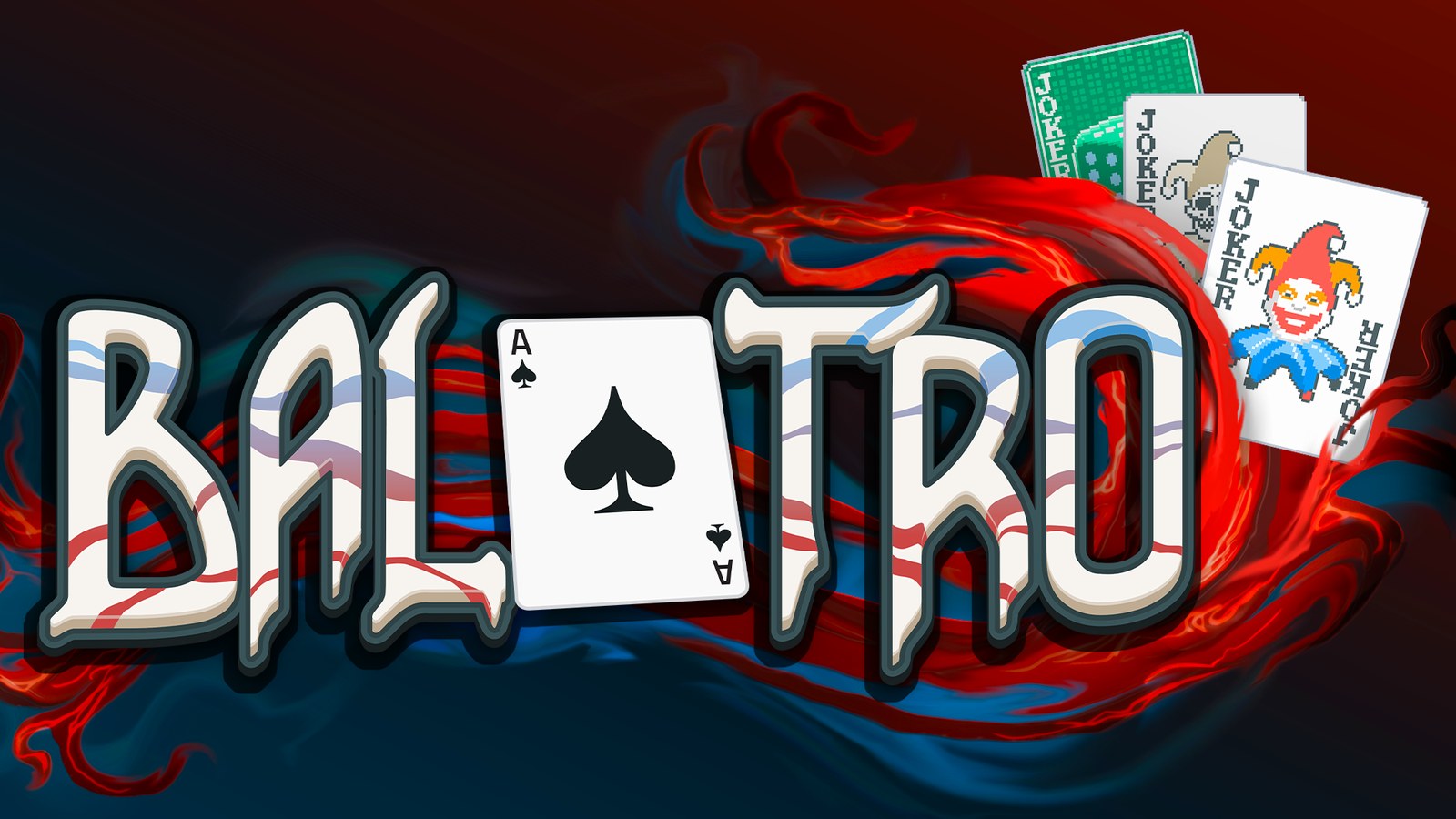
Who made it
The Steam store entry for app 2379780 lists LocalThunk as the developer and Playstack as the publisher. LocalThunk is one person working under a handle, and the publisher's own site and the official game site both carry the Playstack Ltd copyright line, so the split is exactly what it looks like: a solo developer and a UK publisher that handled release, localisation and storefronts.
The developer keeps a blog, and it is the best primary record of how the game came to exist. In a post dated 6 March 2025 titled "The Balatro Timeline", LocalThunk opens by saying that "It's been approximately 3 years since I began work on Balatro - and in that time I have personally documented almost nothing about the journey." The post then reconstructs it from file timestamps. The starting point is 13 December 2021, and the original idea was not a roguelike at all: "The initial idea on Dec 13th was to create an online multiplayer version of Big Cheat, a game that a few friends and I had invented many years prior and played a ton based on the card games Big 2 and Cheat." The scoring rule that the whole game now rests on was there almost immediately. In the developer's words, "The game had the CHIP X MULT mechanic already. I really don't know where this idea came from but it seemed very natural for a scoring system."
The same timeline gives the rest of the shape. The working title through early 2022 was Joker Poker. Development stopped in March 2022 and restarted in May. Full-time work began in January 2023, the name Balatro was settled in April 2023, and the publishing deal with Playstack was signed in July 2023, at which point the timeline records 28,661 Steam wishlists. Launch was 20 February 2024.
When and where it shipped
| Platform | Date | Source |
|---|---|---|
| Windows and macOS (Steam) | 20 February 2024 | Steam store page, app 2379780 |
| Nintendo Switch | 20 February 2024 | Nintendo's official US store listing |
| PlayStation, Xbox, Switch (publisher's list) | 20 February 2024 | Playstack's own game page |
| iOS, Android, Apple Arcade | announced for 26 September 2024 | Gematsu, 5 September 2024 |
| Nintendo Switch 2 | listed as available, no date read | official site store links |
Three limits, stated plainly. First, we could not open an Xbox storefront page for the game on 9 September 2026, so the Xbox console date above rests on the publisher's page and the ESRB certificate's platform list rather than on Microsoft's own listing. Second, the App Store version history shows a version 1.0 with an ambiguous numeric date and a current version 1.3, so we have used Gematsu's dated report of the announced 26 September 2024 mobile launch rather than reading a shipped date off Apple's page. Third, all of these are the North American storefronts; a regional day may differ and is not captured here. The dataset row therefore records 20 February 2024, the date every platform source agrees on.
Prices as listed on 9 September 2026: $14.99 on Steam and on the Nintendo store, $9.99 on the App Store. The Nintendo listing gives the download size as 179 MB and the game as one player on a single system.
What the game does
The publisher and the developer describe it the same way on the official site and the publisher's game page, in one sentence: "The poker roguelike. Balatro is a hypnotically satisfying deckbuilder where you play illegal poker hands, discover game-changing jokers, and trigger adrenaline-pumping, outrageous combos." The longer About text on Steam opens with the mechanical version: "Balatro is a poker-inspired roguelike deck builder all about creating powerful synergies and winning big."
Underneath the marketing the structure is simple and worth understanding before you buy. You hold a hand of standard playing cards and you play poker hands from it, but nobody is betting against you and there is no opponent at the table. A played hand scores a number of chips, that number is multiplied, and the product has to clear a target called a blind. Clear three blinds and you finish an ante; the third is a boss blind with a rule that breaks something you were relying on. Between rounds you spend winnings in a shop, and what you buy is where the game lives.
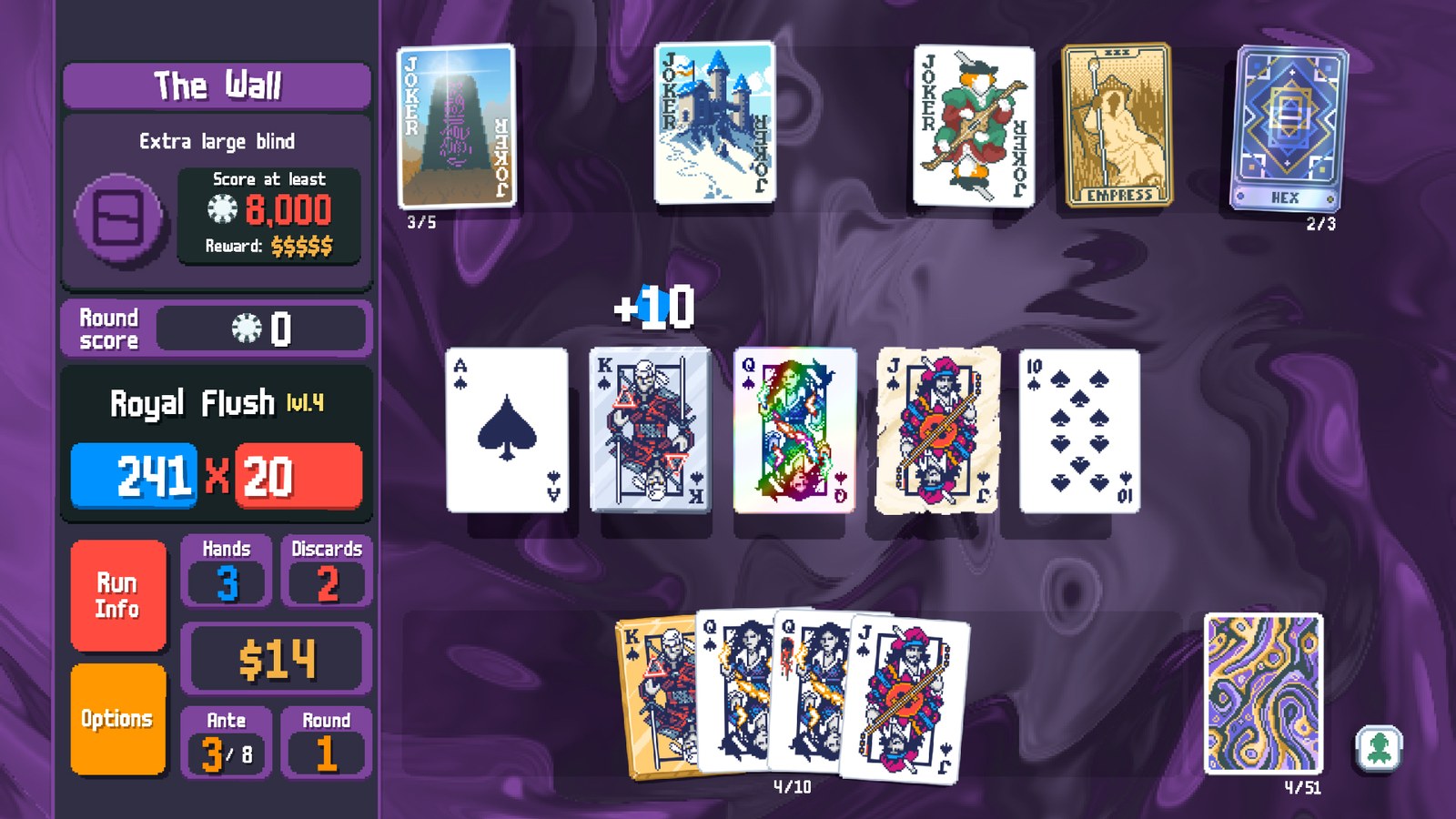
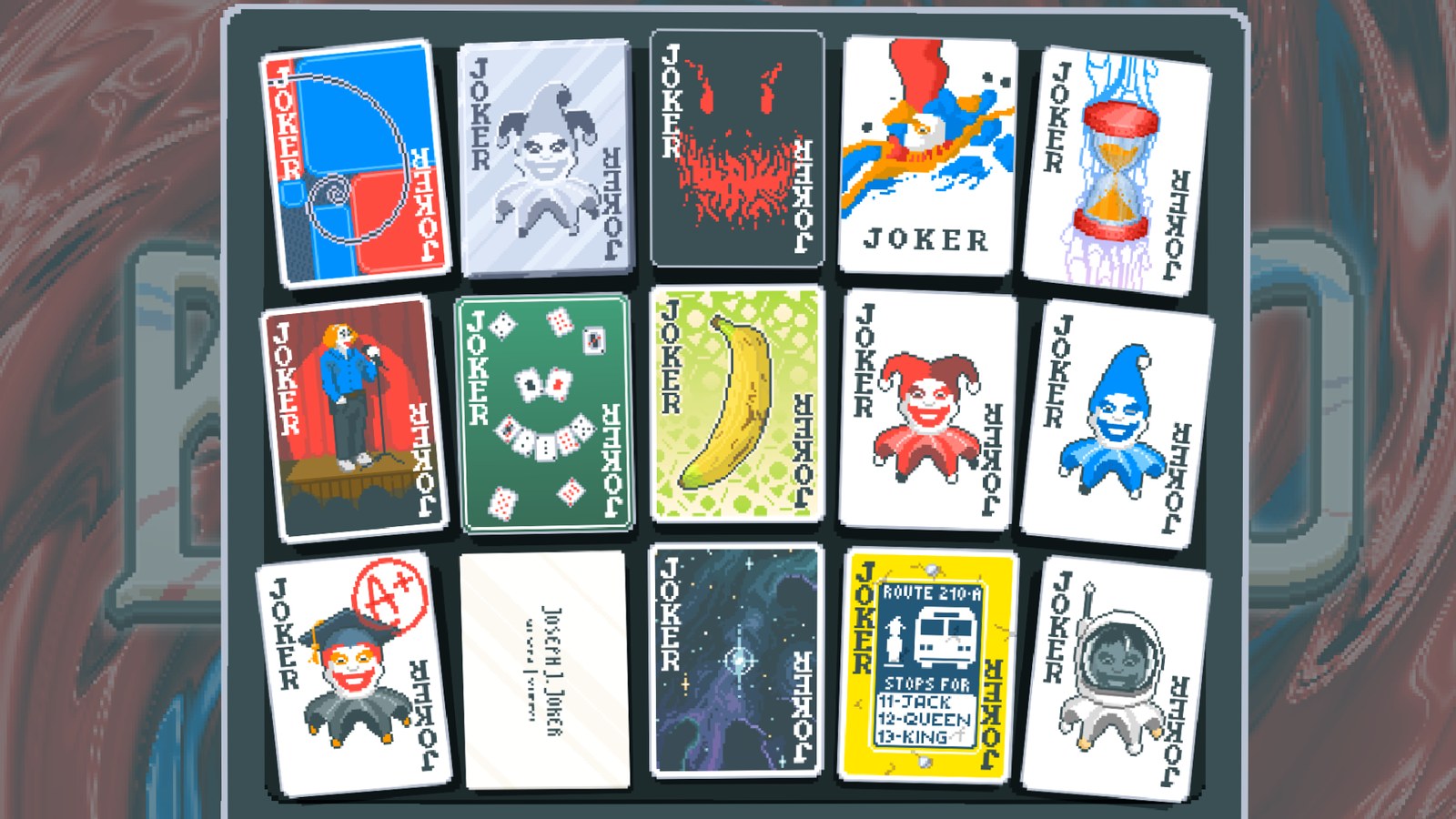
The Steam page counts the pieces: "150 Jokers, each with their own unique abilities", "15 Decks with distinct modifiers to choose from for each run", "5 potential variants of each Joker which add further abilities", "22 Tarot cards variants that can enhance your regular playing cards", "11 Planet cards that help level up your possible poker hands" and "32 Voucher cards to help provide permanent buffs for your current run". Jokers change how scoring works rather than adding a flat bonus, Planet cards raise the base value of a specific hand type permanently for the run, and Tarot cards edit the physical cards in your deck. The campaign runs across eight difficulty stakes, and the page also lists challenge runs and seeded runs, the latter meaning a run you can reproduce exactly or hand to someone else.
The minimum PC specification is the other thing that tells you what this is. Steam asks for 64-bit Windows 7 or newer, an Intel Core i3, 1 GB of RAM, an OpenGL 2.1 compatible card and 150 MB of storage. It is a game about numbers on cards, and it runs on almost anything.
The rating fight
This is the part of Balatro's history that is genuinely instructive, and it is documented on both sides. In late February 2024, days after launch, PEGI rated the game 18 in Europe on the grounds of gambling content, and console storefronts pulled it in affected regions; Push Square reported the removals on 1 March 2024. Game Developer's Chris Kerr, writing on 17 December 2024, quoted LocalThunk's response, which was less a complaint about Balatro's own rating than about the comparison: "Since PEGI gave us an 18+ rating for having evil playing cards maybe I should add microtransactions/loot boxes/real gambling to lower that rating to 3+ like EA sports FC. This is comedy." The developer added, in the same piece, "I'm way more irked at the 3+ for these games with actual gambling mechanics for children than I am about Balatro having an 18+ rating."
PEGI reversed itself. In a statement dated 24 February 2025, the PEGI Complaints Board recorded an appeal by Sold Out Sales and Marketing and amended the classification from 18 to 12, concluding that although the game explains the various hands of poker, it "contained mitigating fantastical elements that warranted a PEGI 12 rating". The same statement handled Luck Be A Landlord the same way, and committed PEGI's Experts Group to building a more granular set of criteria for gambling themes rather than treating them as one switch.
North America never had the dispute. The ESRB certificate rates Balatro Everyone 10+ with the single content descriptor Gambling Themes and, importantly, records No Interactive Elements. Its rating summary calls it "a card simulation/deck-building game in which players create winning hands to earn chips and defeat enemy blinds" and states that the poker theme "does not include making wagers". Two ratings boards, the same game, an eight-year gap in the recommended age, resolved to a six-year gap. If you are deciding for a household rather than yourself, read the ESRB summary and the PEGI statement and make your own call; both are linked below.
Why it matters
Three things, each attached to a source. The commercial one: Playstack announced on 21 January 2025 that the game had passed five million units sold across platforms, and credited a spike in players after The Game Awards. That is a solo developer's first commercial release.
The critical one: at the 2025 Game Developers Choice Awards, per Playstack's own post dated 20 March 2025, Balatro took Game of the Year along with Best Debut, Best Design and the Innovation Award, and the publisher separately records a BAFTA Debut Game win the same year. Steam displays a Metacritic score of 90 for the PC version, which is Steam reporting Metacritic and not a number this site measured.
The design one is the reason the other two happened. Balatro took a scoring vocabulary almost everyone already knows, poker hand rankings, and used it as the tutorial, so the game can start being interesting on the first screen instead of the fifth hour. Everything it then adds is a rule that breaks the familiar thing in a specific way. That is a transferable idea, and it is why the game shows up in design talks rather than only in sales charts.
It is also still being worked on. On 20 February 2026, in a post called "Bad Grades" marking the game's second anniversary, LocalThunk closed with a note that reads, in full, "Yes I'm still working on 1.1". No date has been given for that update, and this page will not invent one.
What to know before starting
- The ratings differ by region and both are defensible. ESRB: Everyone 10+, Gambling Themes, No Interactive Elements. PEGI: 12 since 24 February 2025, previously 18. There is no real-money wagering and no in-app purchase in the game itself.
- Nothing you buy in the shop carries between runs. Vouchers are permanent for the current run only. The things that persist are unlocks, decks and stakes, plus what you have learned.
- Read the Joker text, not the rarity. A common Joker that multiplies at the right moment beats a rare one that adds chips. The Steam page's own framing, "creating powerful synergies", is the actual win condition.
- Start on white stake with the red deck if the default feels thin, and do not raise stakes until you have won once. The eight difficulties are meant to be climbed, not chosen.
- It is single-player, offline, and one purchase. No live service, no season, nothing to miss by starting in 2026 rather than 2024.
- Buy it where you will actually play it. It is on Steam for Windows and macOS, on Switch and Switch 2, on PlayStation and Xbox, and on phones through the App Store, Google Play and Apple Arcade. The phone version is the same game at a lower price and is the one most people end up putting the hours into.
The row in the dataset
The dataset records Balatro with LocalThunk as developer, Playstack as publisher, a first release of 20 February 2024, platforms Windows PC, macOS, Nintendo Switch, PlayStation, Xbox, iOS and Android, the genre deck-building roguelike, and the era current, with the Steam store page as the source URL. It is the second current-era row in the set and the first entry whose developer field names a single person.
Sources
- Steam store page, "Balatro" (developer LocalThunk, publisher Playstack, Steam release date Feb 20, 2024, genres, price, the About This Game text, minimum requirements; read through Steam's public appdetails endpoint on 9 September 2026)
- Playstack Ltd, the official Balatro site (the game's one-line description and the eight storefronts it links)
- Playstack, the publisher's game page (description, platform list, release date February 20, 2024)
- Nintendo, official US store listing (release date February 20, 2024, publisher Playstack, 179 MB, one player, $14.99, ESRB descriptor)
- ESRB, rating certificate for Balatro (Everyone 10+, Gambling Themes, No Interactive Elements, rated platforms, rating summary)
- PEGI, "PEGI Complaints Board Amends Classifications of Balatro and Luck Be A Landlord to PEGI 12", 24 February 2025
- LocalThunk, "The Balatro Timeline", 6 March 2025 (the developer's own month-by-month development chronology)
- LocalThunk, "Bad Grades", 20 February 2026 (the developer on the second anniversary and on version 1.1)
- Playstack, 21 January 2025 (the publisher's five-million-units announcement)
- Playstack, 20 March 2025 (the four GDC Awards)
- Chris Kerr, Game Developer, 17 December 2024 (LocalThunk on the PEGI 18 rating)
- Push Square, 1 March 2024 (the console-store removals during the rating dispute)
- Gematsu, 5 September 2024 (the announced mobile release date and price)
- Apple App Store listing for Balatro (seller Playstack Ltd, $9.99, 13+, 98 MB, current version 1.3)
- Playstack Ltd, "Balatro Press Kit" (the official press-kit page, "Official assets for media use"; the three images on this page were downloaded from it on 10 September 2026)